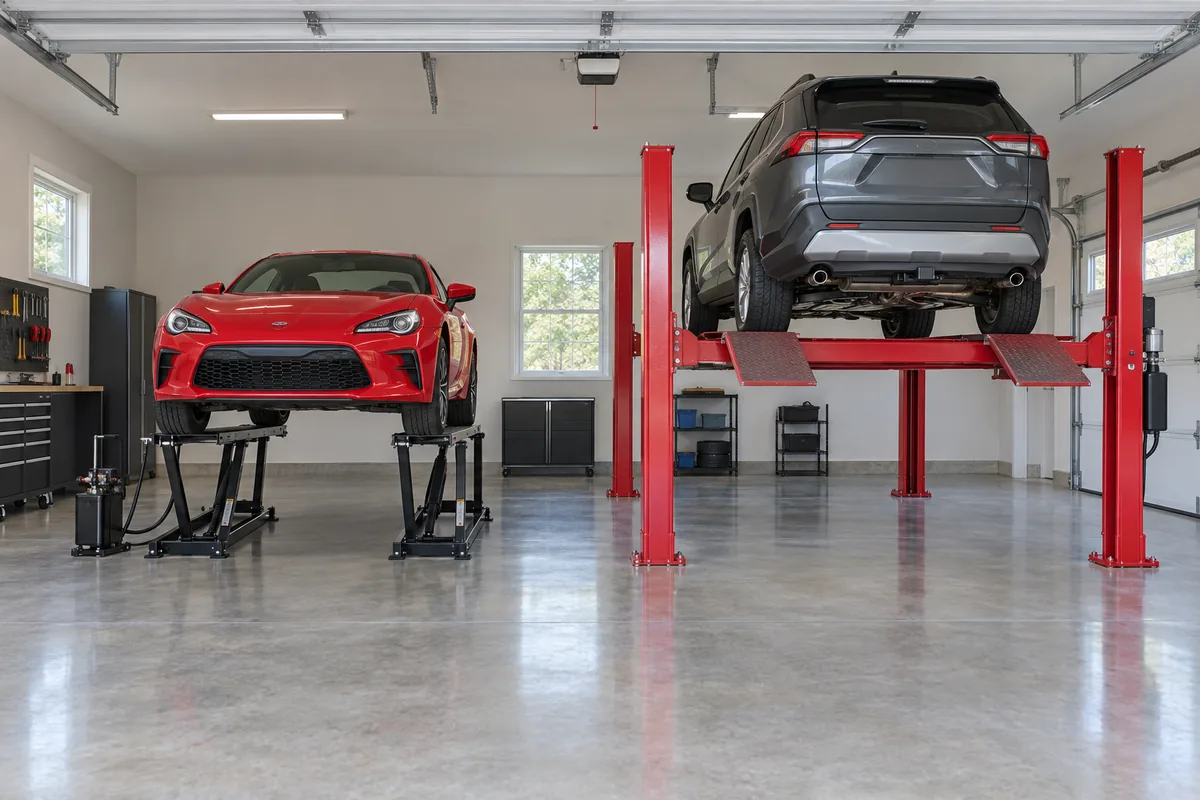
The 4 post vs QuickJack debate is a strange one, because on paper these two are not even in the same category. One is a permanent steel structure that can hold a car in the air for a year. The other is a pair of low frames you slide under a car, lift two feet, and hang on the wall when you are done. Yet almost every home mechanic I talk to ends up cross-shopping exactly these two, and for a good reason: both let you get under a car without jack stands, and both land in the same $1,500 to $5,000 budget.
I own both. The QuickJack lives in my single bay at home where the ceiling is barely 8 feet, and it has done every brake job, oil change and suspension refresh on my daily drivers for years. The 4 post lift lives in the shop, where it stores a project car over a winter beater and doubles as an oil change platform. They are both excellent, and they are both terrible at what the other one does.
In this comparison I will explain what a QuickJack actually is, how it stacks up against a 4 post lift on access, height, storage, ceiling, footprint, setup, safety and price, and then tell you honestly which one belongs in your garage. If you are still weighing other lift styles, our 4 post vs scissor lift and 4 post vs 2 post car lift comparisons cover the rest of the field.
Quick Answer: A QuickJack is the right buy if your ceiling is under 10 feet, you need the floor back when you are done, your work is brakes, wheels, oil changes and suspension, and you want to spend $1,500 to $2,200 with zero installation. A 4 post lift is the right buy if you want to park one car above another, stand upright under the vehicle, lift trucks over 7,000 lbs, or use the lift as a long-term storage platform, and you have 11 feet or more of ceiling plus $2,500 to $8,000. The QuickJack is the best jack stand replacement ever made; the 4 post lift is a second parking space that happens to lift cars.
Also Check:
- Best 4 Post Car Lift for the Money – Reviews & Buying Guide
- 4 Post vs Scissor Lift: Which Car Lift Is Right for Your Garage?
- 4 Post vs 2 Post Car Lift: Which One Should You Buy?
- Does a 4 Post Car Lift Need to Be Anchored? The Ultimate Guide
4 Post Lift vs QuickJack: Quick Comparison
Here is the whole comparison at a glance. The rest of the article explains why each row falls the way it does.
| Feature | QuickJack (portable frame lift) | 4 Post Lift |
|---|---|---|
| What it is | Two independent low-rise hydraulic frames plus a 15 lb power unit | Four columns, two crossbeams and two drive-on runways |
| Capacity | 3,500–7,000 lbs (newest models to 8,000 lbs) | 7,000–14,000 lbs for home units; more for commercial |
| Max lift height | 21–24.5 in (up to 27 in with adapters) | 70–78 in |
| Working position | On your back or a creeper | Standing upright |
| Ceiling needed | Any garage; 8 ft is plenty | 11–14 ft to stack two vehicles |
| Footprint in use | Two frames 62–87 in long under the car | Roughly 10 ft x 17–20 ft |
| Footprint stored | Hangs on a wall bracket; 3–3.5 in thick frames | Permanent; same footprint at all times |
| Vehicle support | Frame or pinch welds via rubber blocks | Tires on runways |
| Wheels-free work | Yes, immediately | Only with rolling bridge jacks ($500–$1,200 each) |
| Two-car storage | No | Yes |
| Setup per use | About 5 minutes to position frames and hoses | About 30 seconds to drive on |
| Rise time | About 30 seconds | About 1 minute |
| Installation | None; unbox, fill, bleed, use | Half to full day with 2–3 people; anchoring recommended |
| Power | 110V household outlet (208–240V optional) | 220V for most models |
| Portability | Fits in a car trunk; take it to the track or a new house | Moveable only with a caster kit, and slowly |
| Safety locks | Automatic locks at two heights | Mechanical locks every few inches in each column |
| 2026 price | $1,500–$2,200 | $2,500–$8,000 (budget storage units from $2,000) |
QuickJack figures come from QuickJack’s published specifications and Car Lift Lab’s portable lift guide, 4 post figures from Car Lift Lab’s 2026 cost guide. Prices move, so check the current listing before you buy.
What Is a QuickJack?
QuickJack is a brand of portable low-rise frame lift made by BendPak, and it has become shorthand for the whole category the way Kleenex did for tissues. The system is two independent steel frames, each about 3 inches tall when collapsed, that slide under the sides of the car. Rubber lift blocks sit on the frames under the factory pinch welds or frame rails. A small electric-hydraulic power unit, plugged into an ordinary 110V outlet, pushes fluid to both frames at once and raises the car in about 30 seconds. Automatic safety locks catch the frames at two heights on the way up.
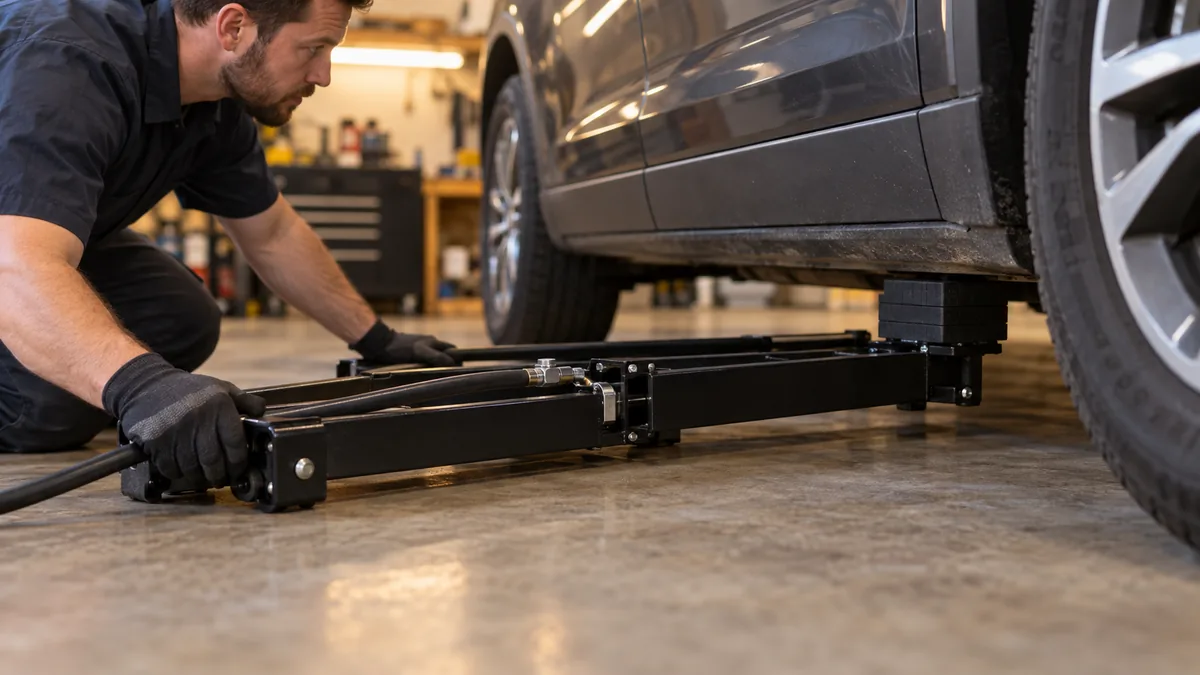
The current lineup is easy to decode. The number is the capacity, TL means a standard 70 inch frame and TLX means an extended 76 inch frame for long-wheelbase vehicles, based on QuickJack’s published specifications:
| Model | Capacity | Max height | Frame length | Frame weight | Lift point spread | Best for |
|---|---|---|---|---|---|---|
| BL-3500SLX | 3,500 lbs | 21 in | 62.5 in | 60 lbs | 27–50.5 in | Sports cars, compacts, race cars |
| 5000TL / 6000TL | 5,000–6,000 lbs | 24 in | 70 in | 78–85 lbs | 37–60 in | Sedans, coupes, small crossovers |
| 5000TLX / 6000TLX | 5,000–6,000 lbs | 24 in | 76 in | 81–85 lbs | 43–66 in | Long-wheelbase cars |
| 7000TL | 7,000 lbs | 24.5 in | 70.75 in | 98 lbs | 37–60 in | Mid-size trucks and SUVs |
| 7000TLX / 8000TLX | 7,000–8,000 lbs | 24.5 in | 76 in | 98–103 lbs | 43–66 in | Full-size trucks and long SUVs |
According to Garage Loadout’s QuickJack buying guide, the 5000 and 7000 series are being superseded by 6000TL, 6000TLX and 8000TLX versions that add 1,000 lbs of capacity on the same frames, so you may see both generations on sale at once. All current TL and TLX models are ALI certified, which is rare in the portable category and matters for insurance and peace of mind.
What a QuickJack is not is a lift you walk under. Two feet of rise puts the car at the same height as a good set of jack stands, just faster, more stable and with all four wheels off the ground at once. You will still be working on your back or a creeper.
What Is a 4 Post Lift?
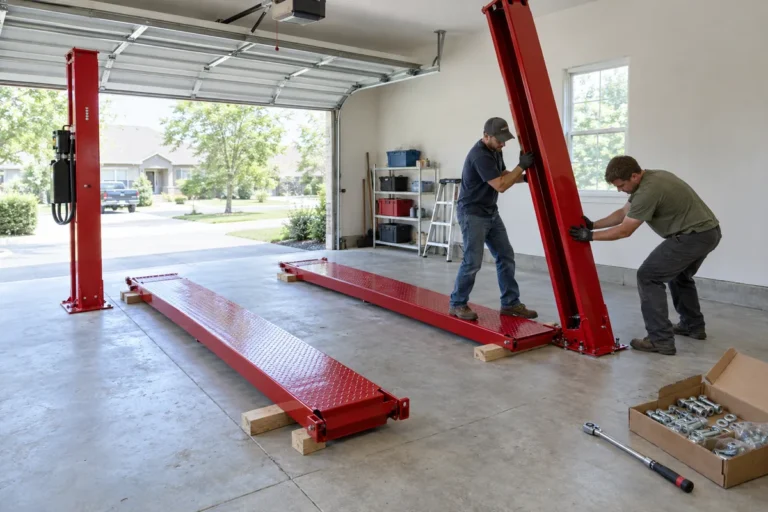
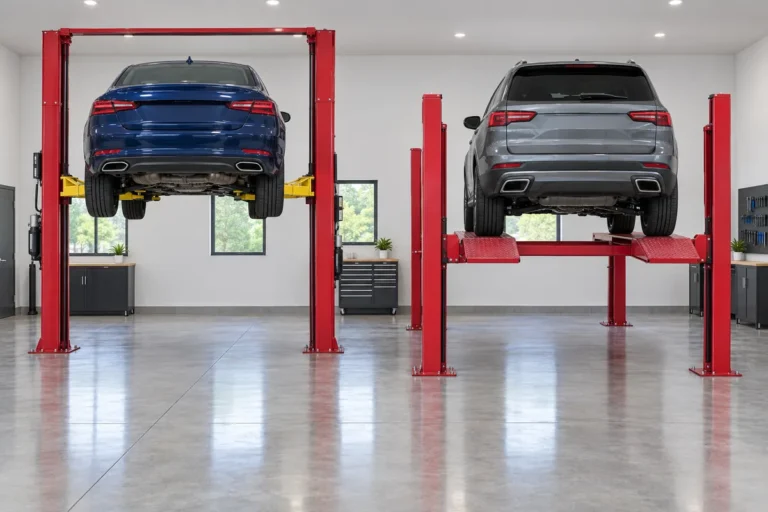
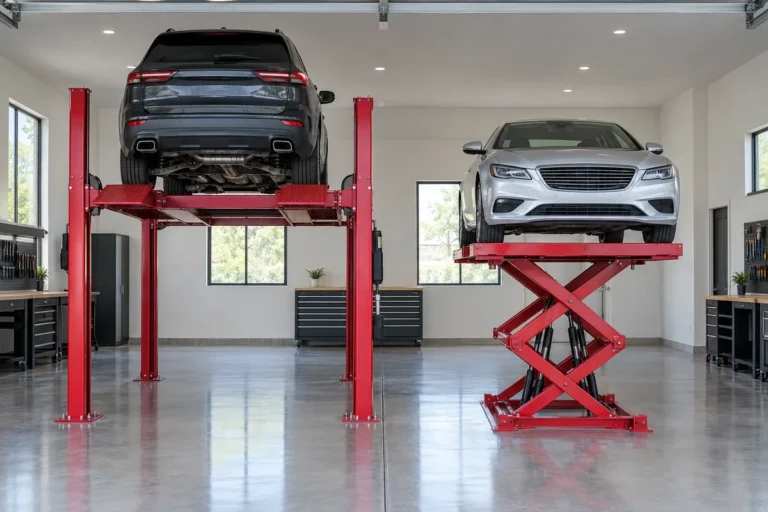
A 4 post lift is a drive-on platform. Four columns stand at the corners, two crossbeams tie them together, and two full-length runways sit on the crossbeams. You drive the car up the ramps, flip the ramps up as wheel stops, and a hydraulic cylinder pulls four equalizer cables that raise the runways evenly. Mechanical safety locks click into each column every few inches. Home units are rated from 7,000 to 14,000 lbs and lift to 70 to 78 inches, which is full standing height.
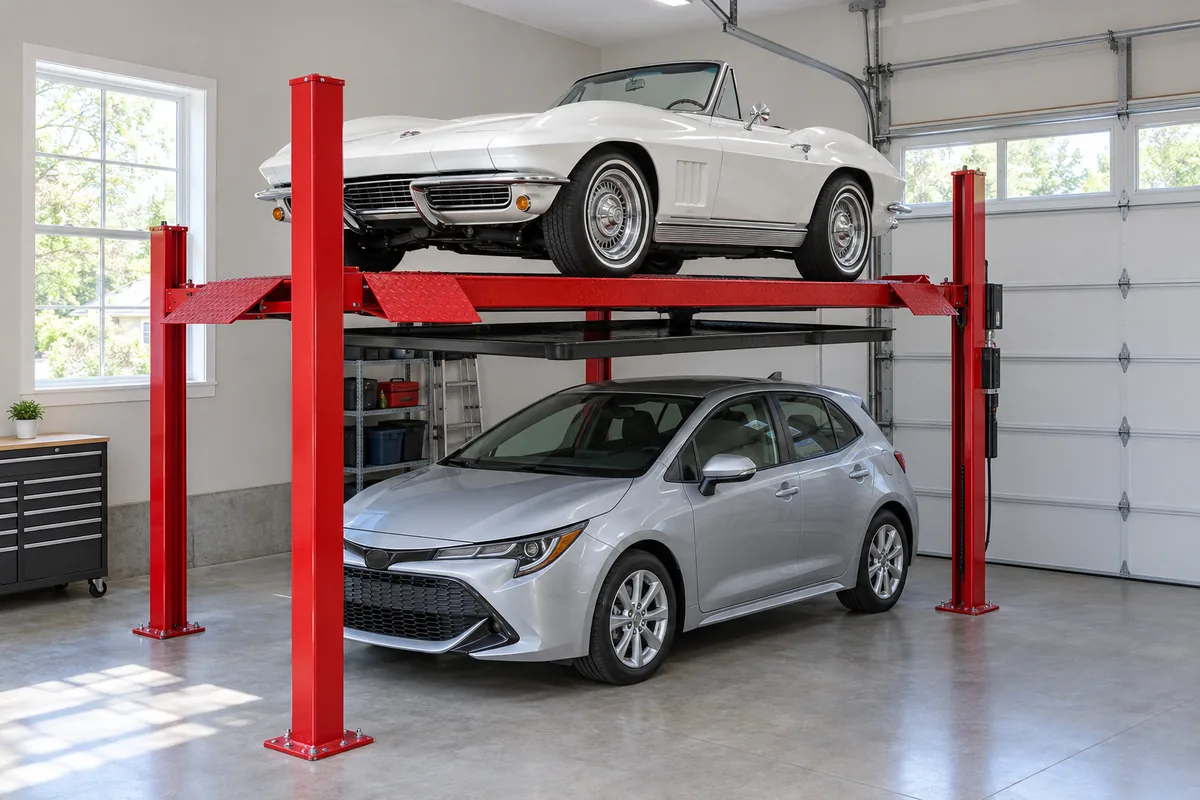
The 4 post lift is the storage lift. Park a car on the runways, lower it onto the locks, park another underneath, and you have doubled the capacity of a bay. It is also the most relaxed lift to service a car on, because you drive on with no lift points to find and stand upright underneath. The catch is that the tires stay loaded and the runways sit under the middle of the car, so wheel and brake work needs rolling bridge jacks. If you are shopping for one, our roundup of the best 4 post car lifts covers the models I recommend most.
4 Post vs QuickJack: Head-to-Head
Lift Height and Working Position
This is the most important difference and the one people underestimate. A QuickJack tops out at 21 to 24.5 inches, or about 27 inches with the pin adapters. That is plenty to pull wheels, do brakes, drop an oil pan or swap coilovers, but you are lying down for all of it. A 4 post lift raises the car to 70 to 78 inches, so you stand under it with a work light, a creeper nowhere in sight.
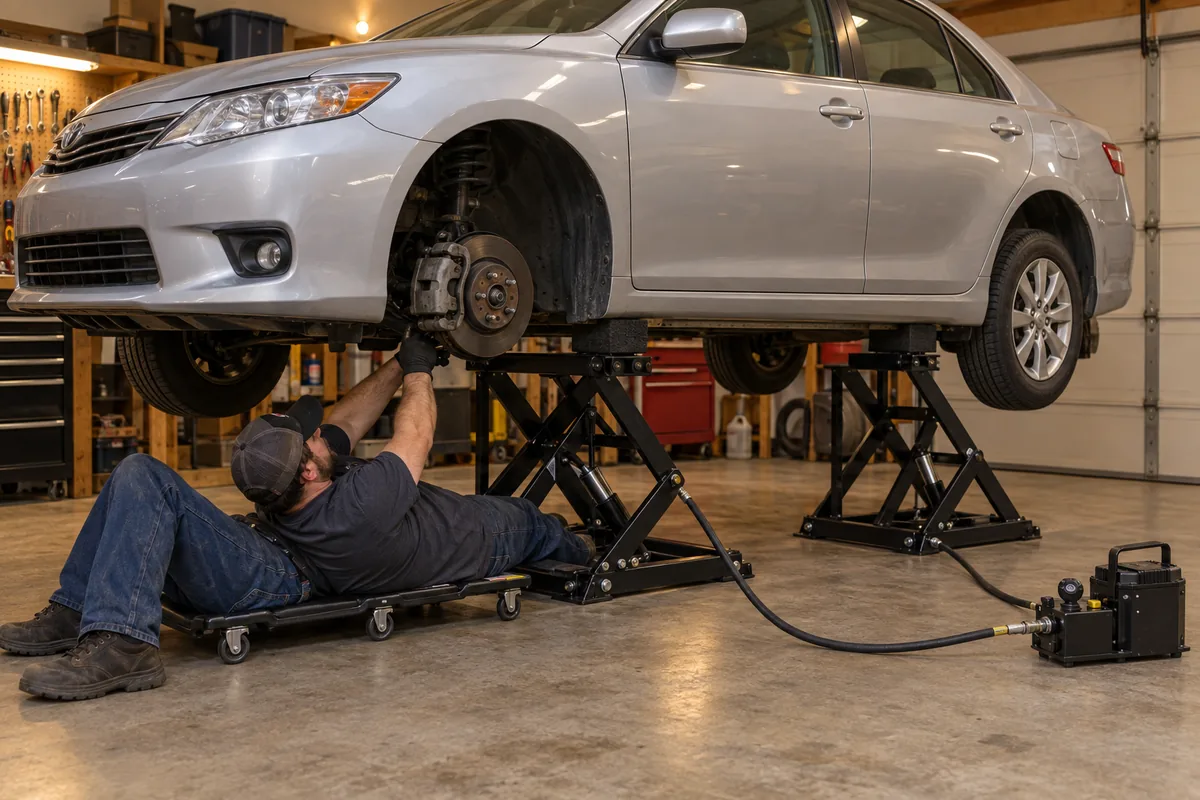
If your back is the limiting factor in your garage time, that alone may decide the question. If you are happy on a creeper and mostly work around the wheels, the QuickJack’s height is a non-issue.
Winner: 4 post lift.
Ceiling Height
A QuickJack does not care about your ceiling. It raises the car two feet, so it works in any garage a car will fit into, including 8 foot tract home garages, carports and even a paved driveway. A 4 post lift needs roughly 11 to 12 feet of clear ceiling to stack two normal cars and 12 to 14 feet for trucks and SUVs. It will physically fit under 10 feet, but you will not get full rise or a second vehicle underneath.
Winner: QuickJack, and for many garages this ends the debate.
Floor Space and Storage
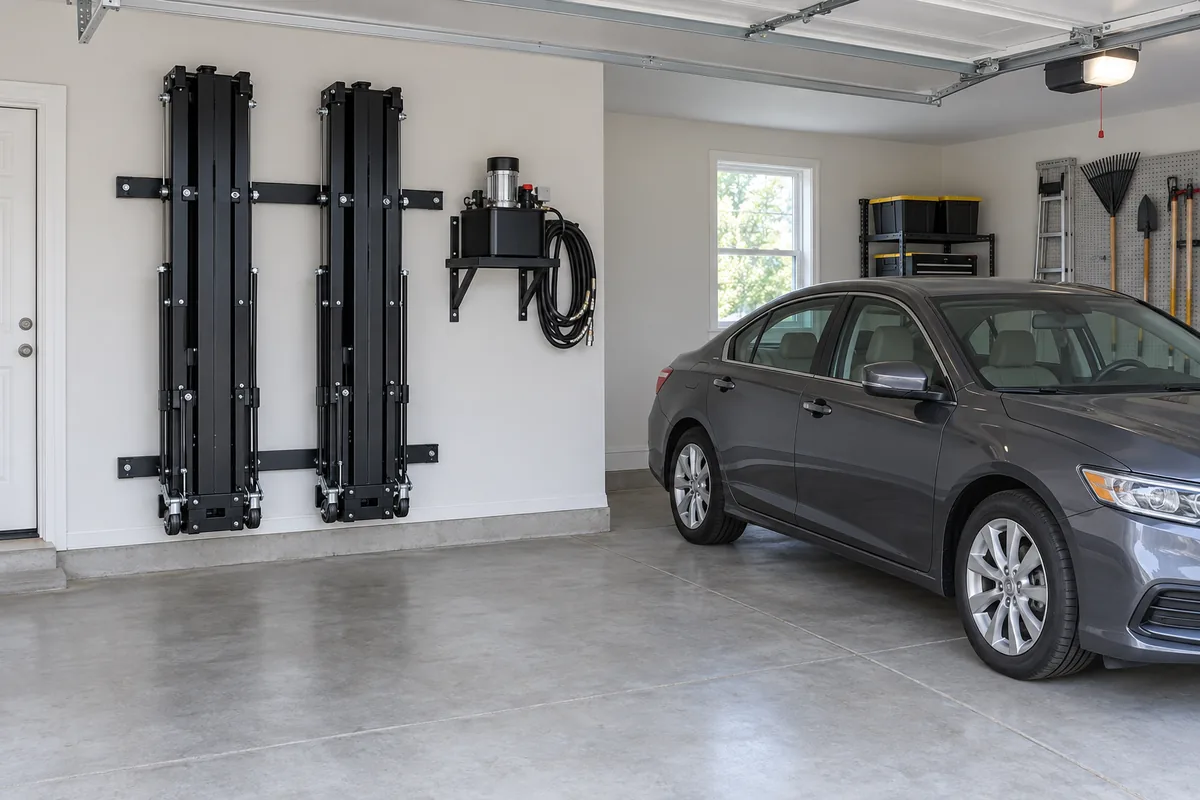
A 4 post lift claims a roughly 10 by 17 to 20 foot rectangle permanently. A QuickJack claims nothing. The frames roll under the car when you need them and hang on an optional wall bracket when you do not, and the 15 lb power unit sits on a shelf. When the job is done, the garage goes back to being a garage.
Winner: QuickJack.
Vehicle Storage
Here the QuickJack has nothing to offer. It lifts one car two feet and nothing parks beneath it, and it is not designed to hold a car up for weeks at a time. A 4 post lift is built for exactly that. If your motivation is a second parking spot, a winter home for a classic, or getting the project car off the floor for months, there is only one choice on this page.
Winner: 4 post lift, and it is not close.
Access and Type of Work
The QuickJack lifts by the frame, so all four wheels hang free instantly. Brakes, rotors, tires, wheel bearings, control arms, sway bars, shocks and springs are all right there, and the center of the car is open between the two frames, so oil changes, exhaust and transmission fluid are easy too. What you cannot do comfortably is anything that needs standing room, a transmission jack, or a full-height view of the underside.
The 4 post lift is the opposite. Drive on and you have standing-height access to the exhaust, driveshaft, oil pan, differential and fuel system, with the runways in the way of the center of the car and the tires still loaded. Add a pair of bridge jacks and it will do wheel work as well, at extra cost and with an extra step each time. For a deeper look at how runway lifts compare to open-floor lifts, see our 4 post vs 2 post car lift comparison.
Winner: QuickJack for wheels-off jobs on cars; 4 post lift for standing-height under-car work.
Setup and Ease of Use
A 4 post lift is the easiest lift in the world to use: drive up, stop at the wheel stops, raise. A QuickJack takes about five minutes each time. You drag two 80 to 100 lb frames into position, line up the blocks under the pinch welds, connect two hoses, raise a few inches, check all four blocks, then go up. It is not hard, but on a cold night the frames are heavy and the hoses are always in the way. Many owners buy the optional frame wheel kit and wall hanger to make the routine tolerable.
Winner: 4 post lift.
Installation and Concrete
A QuickJack needs no installation. Unbox it, fill the power unit, bleed the frames, and lift. It works on any solid, level surface and never needs to be bolted down. A 4 post lift arrives on a 1,500 to 2,200 lb pallet, takes two or three people most of a day to assemble, usually wants a 220V circuit and should sit on at least 4 inches of 3,000 PSI concrete. Most home units can stand free, and we cover whether a 4 post lift needs to be anchored separately, but it is still a project.
Winner: QuickJack.
Capacity and Vehicle Fit
QuickJack capacities run 3,500 to 7,000 lbs, or 8,000 lbs on the newest TLX, which covers almost every car and half-ton truck. The real fitment issue is frame length and lift point spread: the frames must reach your car’s lift points, which is why the TLX exists for long-wheelbase vehicles and why the 3500SLX may not reach the jack points on a large sedan. A 4 post lift lifts by the tires, so fitment is about runway length and inside width rather than lift points, and 9,000 to 14,000 lb units handle three-quarter and one-ton trucks that no QuickJack will.
Winner: 4 post lift for trucks and mixed fleets; tie for ordinary cars.
Portability
A QuickJack breaks down into two frames and a power unit that fit in the trunk of a mid-size car. People take them to the track, lend them to friends and move them from house to house. A 4 post lift can be relocated with a caster kit, but that means rolling a ton of steel across a garage, not putting it in a car.
Winner: QuickJack.
Safety
Both are ALI certified in their current forms and both are far safer than jack stands. The 4 post lift is the more forgiving of the two because the car sits on its tires on a wide base and the locks engage at many heights. The QuickJack depends on correct block placement at every lift, and its locks catch at only two positions, so you always lower onto a lock before you go under. Both are safe in careful hands; the QuickJack simply asks for a little more care.
Winner: Slight edge to the 4 post lift.
Price
Based on 2026 pricing at Car Lift Lab’s portable lift guide, a QuickJack runs about $1,500 for a 5000TL to roughly $2,000 to $2,200 for a 7000TLX or 8000TLX, and that is the whole cost: no installation, no electrician, no anchors. Home 4 post lifts run $2,500 to $8,000 with most buyers spending $3,000 to $5,000, per Car Lift Lab’s 2026 cost guide, plus $200 to $500 for a 220V circuit, $500 to $1,500 for installation if you hire it out, and $1,000 to $2,400 for a pair of bridge jacks if you want wheels-free service.
Winner: QuickJack on price; 4 post lift on value if you need the parking space.
QuickJack Pros and Cons
| Pros | Cons |
|---|---|
| Works under any ceiling, even outdoors | Only 21–24.5 in of rise; you work on your back |
| Zero installation and no anchoring | About 5 minutes of setup on every use |
| All four wheels free immediately | Heavy 80–100 lb frames to drag around |
| Stores on the wall; floor space returns | No vehicle storage capability |
| Runs on a 110V outlet; fits in a trunk | Frames must match your vehicle’s lift points |
| ALI certified and $1,500–$2,200 all in | Hoses and power unit are always underfoot |
4 Post Lift Pros and Cons
| Pros | Cons |
|---|---|
| Stores a second car underneath | Needs 11–14 ft of ceiling to stack vehicles |
| Standing-height access under the car | Permanent 10 x 17–20 ft footprint |
| Drive on in 30 seconds, no lift points | Tires stay loaded; bridge jacks cost extra |
| Lifts heavy trucks up to 14,000 lbs | Runways block the center of the undercarriage |
| Stable, forgiving and freestanding | Day-long assembly, 220V, pallet delivery |
| Doubles as a long-term storage platform | $2,500–$8,000 before accessories |
Which One Should You Buy?
Buy a QuickJack If…
- Your ceiling is under 10 or 11 feet, or you work in a carport or driveway.
- You need the garage to return to normal parking when you are done.
- Your work is brakes, wheels, tires, suspension, oil changes and detailing.
- You want to spend $1,500 to $2,200 and start using it the day it arrives.
- You rent, move often, or want to take the lift to the track.
Buy a 4 Post Lift If…
- You want a second parking space or long-term storage for a project or classic.
- You have 11 feet or more of clear ceiling and a bay you can dedicate to the lift.
- You want to stand upright under the car.
- You own trucks or SUVs over 7,000 lbs.
- You are willing to spend $3,000 to $6,000 all in and accept a day of assembly.
My verdict: the QuickJack is the best $1,500 to $2,000 most home mechanics will ever spend, and if your ceiling is low or your garage is shared, buy it without a second thought. But if you have the height and you want a parking space as much as a lift, the 4 post lift is the more transformative purchase. In a perfect garage you own both, and plenty of people do.
And if you want full standing-height access with the wheels free and no storage, neither of these is your answer. Look at a 2 post lift instead.
Frequently Asked Questions
Is a QuickJack as good as a 4 post lift?
They are built for different jobs. A QuickJack raises a car 21 to 24.5 inches with the wheels free and stores on the wall, which makes it ideal for brakes, wheels and suspension in low garages. A 4 post lift raises a car to standing height and can store a second vehicle underneath. Neither replaces the other.
How high does a QuickJack lift a car?
Standard QuickJack models lift 21 to 24.5 inches depending on the model and lift block, and up to about 27 inches with the frame extension adapters and pin. You work on your back or a creeper rather than standing.
Can you store a car on a QuickJack?
No. A QuickJack is a service lift meant to be raised, used and lowered. Nothing can park beneath a car on a QuickJack and it is not designed for long-term storage. A 4 post lift is the correct tool for storing one vehicle above another.
Does a QuickJack need to be bolted down?
No. A QuickJack is fully portable and works on any solid, level surface without anchoring. Most 4 post lifts can also stand free, though anchoring is recommended for stability.
What ceiling height do I need for a QuickJack vs a 4 post lift?
A QuickJack works under any ceiling a car fits under, including 8 foot garages. A 4 post lift needs about 11 to 12 feet of clear ceiling to stack two normal cars and 12 to 14 feet for trucks and SUVs.
Which QuickJack model should I buy?
Match capacity and frame length to your vehicle. The 3500SLX suits sports cars and compacts under 3,000 lbs, the 5000TL or 6000TL suits most sedans and small crossovers, the TLX versions add a longer 76 inch frame for long-wheelbase cars, and the 7000TL, 7000TLX or 8000TLX handle trucks and full-size SUVs.
How much does a QuickJack cost compared to a 4 post lift?
In 2026 a QuickJack costs about $1,500 to $2,200 with no installation costs. A home 4 post lift costs $2,500 to $8,000 for the lift, plus a 220V circuit, possible installation labor and $1,000 to $2,400 for bridge jacks if you want wheels-free service.
Is a QuickJack safe?
Yes. Current QuickJack TL and TLX models are ALI certified and use automatic mechanical safety locks at two heights. Place the rubber blocks on the manufacturer’s lift points, raise a few inches and check all four blocks before going to full height, and always lower onto the locks before working underneath.
Final Thoughts
The 4 post vs QuickJack question usually answers itself the moment you measure your ceiling and admit what you use the garage for. Under 10 feet, or in a shared family garage, the QuickJack is a gift: cheap, portable, safe, and gone when you are finished. Over 11 feet, with a car you want off the floor and a second one that needs a home, the 4 post lift changes what your garage can do.
Neither is a compromise. They are two different tools, and the smartest buyers I know figure out which problem they actually have before they fall in love with a lift. Measure twice, buy once, and enjoy never touching a jack stand again.