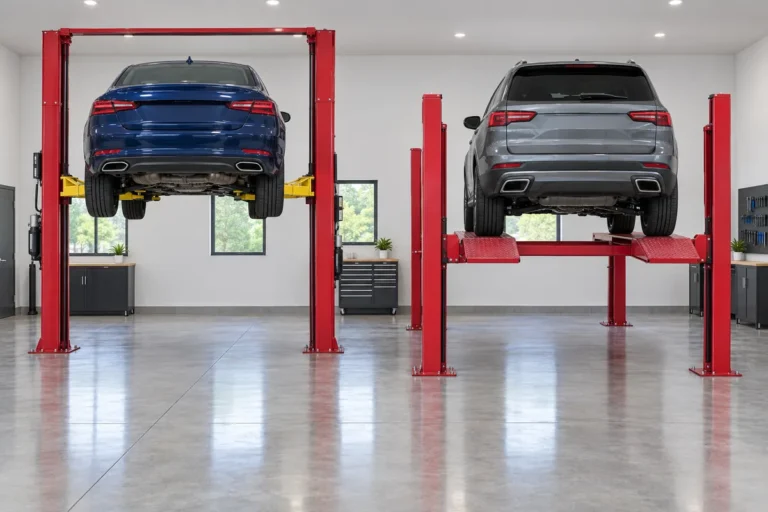
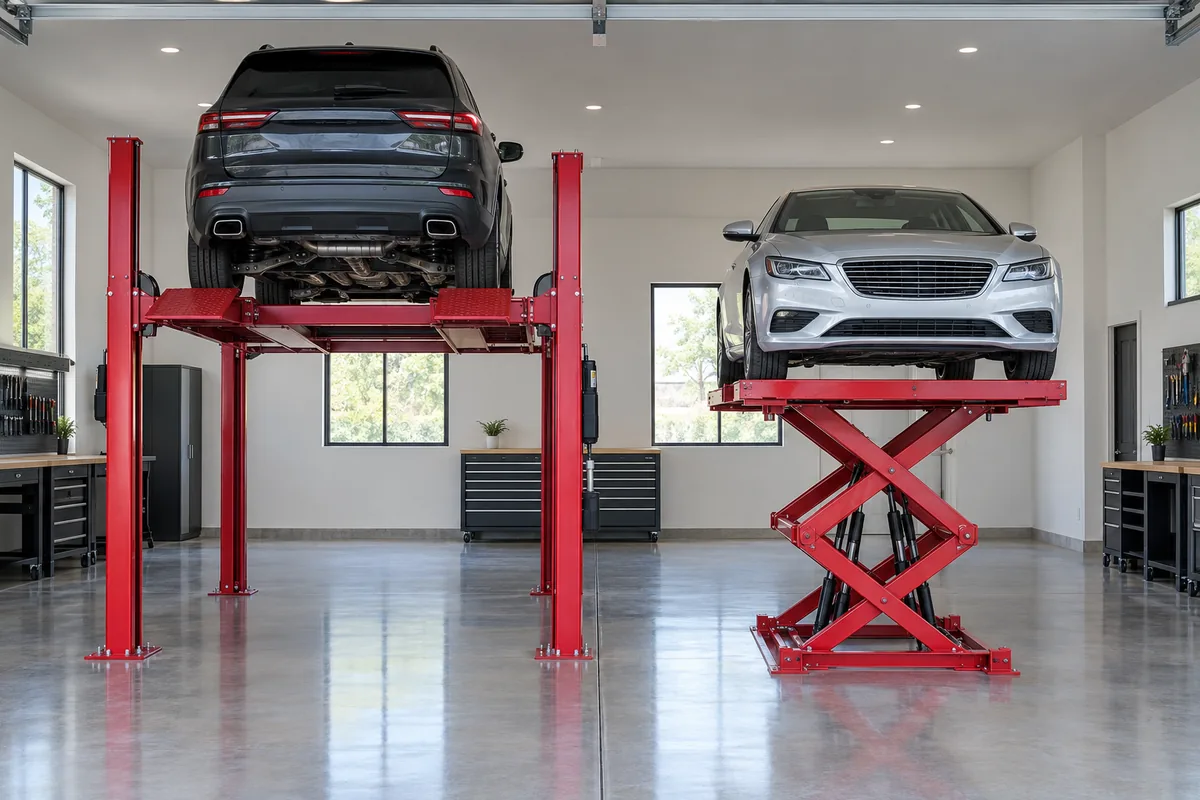
Every week someone emails me the same question in slightly different words: I have a two car garage, a decent budget and a car I actually want to work on, so should I buy a 4 post lift or a scissor lift? And every week my honest answer starts with another question, because the 4 post vs scissor lift debate is not really about which lift is better. It is about what you want the lift to do and what your garage will physically allow.
I have owned both. My 4 post lift has spent most of its life as a parking space for a project car with my daily driver tucked underneath. My mid-rise scissor lift has done more brake jobs, tire swaps and suspension work than I care to count, and it lives flat on the floor when I am not using it. They are excellent tools that solve completely different problems.
In this comparison I will walk you through how each lift works, where each one wins, what they really cost in 2026, and the ceiling, concrete and floor space numbers that decide the question for most home garages. By the end you will know which one belongs in yours.
Quick Answer: Choose a 4 post lift if you want to store one car above another, need 9,000 lbs or more of capacity, and have an 11 to 14 foot ceiling and room for a permanent 10 by 17 foot footprint. Choose a scissor lift if your ceiling is 8 to 10 feet, floor space is tight, you mostly do wheels, brakes, suspension and oil changes, and you want the lift to disappear when you are done. A 4 post lift is the storage and drive-on convenience winner; a scissor lift is the low ceiling, small garage, quick service winner.
Also Check:
- Best 4 Post Car Lift for the Money – Reviews & Buying Guide
- Does a 4 Post Car Lift Need to Be Anchored? The Ultimate Guide
- Best Two Post Lift to Buy – Reviews & Guide
4 Post Lift vs Scissor Lift: Quick Comparison
Here is the whole argument in one table. The scissor lift numbers cover the three common sizes you will actually shop for, because a portable low-rise unit and a full-rise scissor lift are very different machines.
| Feature | 4 Post Lift | Low-Rise Scissor (portable) | Mid-Rise Scissor | Full-Rise Scissor |
|---|---|---|---|---|
| Typical capacity | 7,000–14,000 lbs (home); up to 30,000+ commercial | 3,500–8,000 lbs | 6,000–10,000 lbs | 7,000–18,000 lbs |
| Max lift height | 70–78 in (standing height) | 18–30 in | 30–60 in | 60–72 in |
| Ceiling needed | 11–14 ft to stack two cars | 8 ft is fine | 9–10 ft | 12 ft or more |
| Footprint | Permanent, roughly 10 ft x 17–20 ft | Two small frames, stores against a wall | Flat platform, often flush when lowered | Full-length platform, semi-permanent |
| Vehicle support | Tires on runways | Frame or pinch welds | Frame or pinch welds | Frame or pinch welds |
| Wheels-free work | Needs rolling bridge jacks ($500–$1,200) | Yes | Yes | Yes |
| Center undercarriage access | Blocked by runways | Partial | Blocked by platform | Partial |
| Two-car storage | Yes | No | No | No |
| Installation | Medium to high; anchoring recommended | None, plug and play | Low to medium; bolt to slab | Medium; bolt or flush mount |
| Power | 220V (some 110V) | 110V | 110V or 220V | 220V |
| 2026 price | $2,500–$8,000 home; $5,000–$12,000 commercial | $1,000–$2,150 | $2,000–$5,000 | $10,000 and up |
Capacity, height and price ranges are drawn from current 2026 buyer guides at Car Lift Lab and installer data from Auto Lift Services, cross-checked against manufacturer listings. Always confirm against the exact model you are buying.
How a 4 Post Lift Works
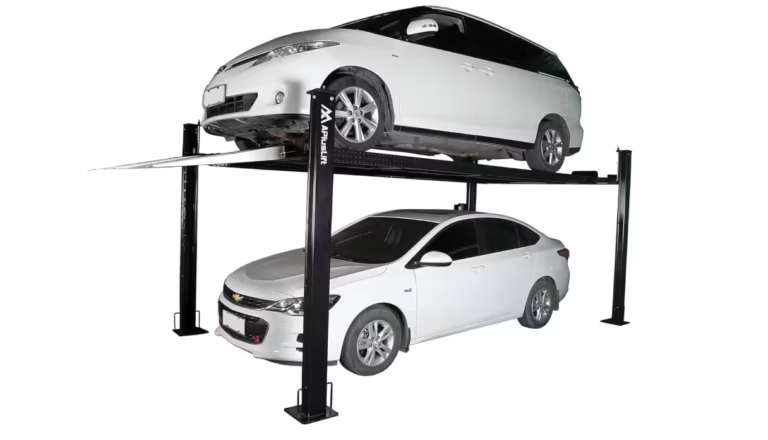
A 4 post lift is the simplest lift to understand. Four steel columns stand at the corners, two crossbeams tie them together, and two full-length runways sit on the crossbeams. You drive the car up the ramps onto the runways, pull the ramps up as wheel chocks, press the button, and a single hydraulic cylinder pulls a set of equalizer cables that raise all four corners together. Safety locks click into the columns every few inches on the way up.
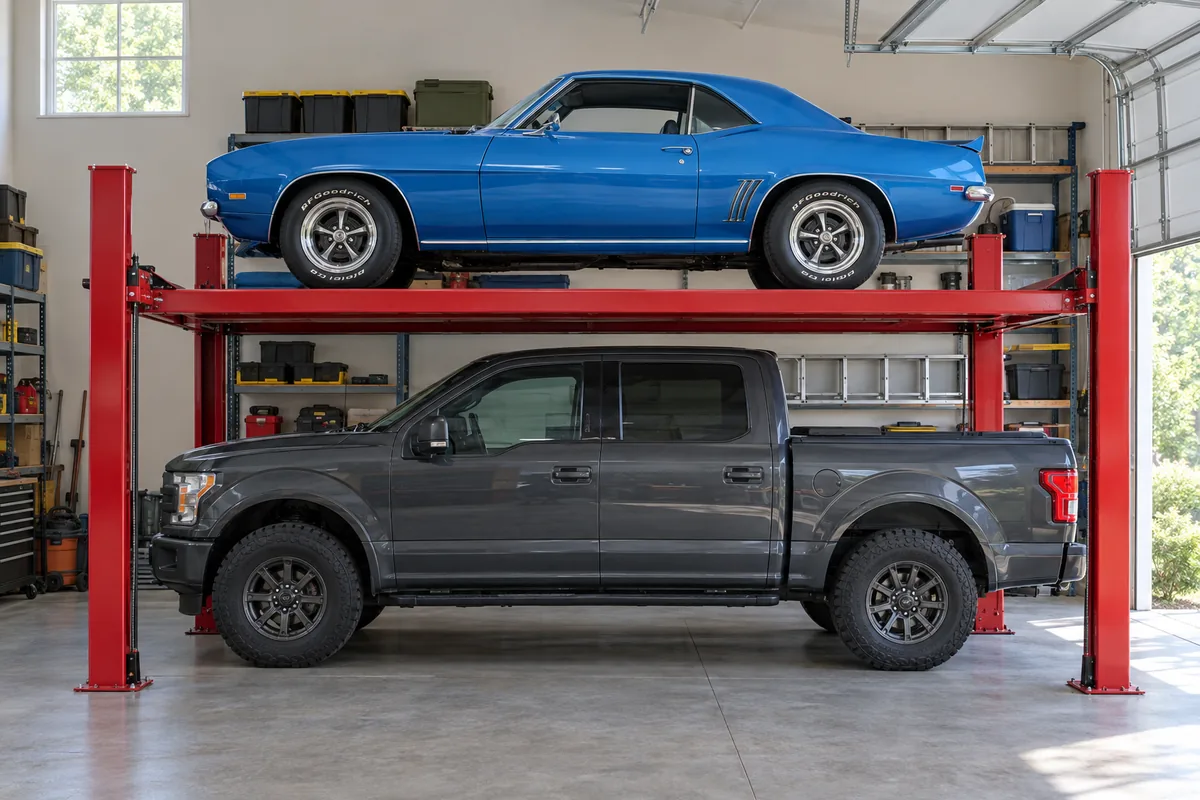
Because the car sits on its tires the whole time, there is no fussing with lift points, no risk to rocker panels and nothing to check underneath before you press go. That is why 4 post lifts dominate home garages for storage and why they are the drive-on lift of choice for oil changes, exhaust work and inspections. If you are shopping for one, our roundup of the best 4 post car lifts covers the models I recommend most often.
The trade-off is that the tires stay loaded. To do brakes, wheels or suspension you add rolling bridge jacks that span the runways and pick the car up by the frame. That is an extra $500 to $1,200 per jack, and you usually want two.
How a Scissor Lift Works
A scissor lift raises the vehicle from underneath using a folding X-shaped frame driven by hydraulic cylinders. Instead of lifting by the tires, it engages the frame rails or pinch welds with rubber blocks, so the wheels hang free the moment the car leaves the ground. There are no columns at the corners, which is the whole point: the entire mechanism lives under the car.
The category splits into three sizes you will run into while shopping:
- Low-rise or portable scissor lifts (QuickJack style) raise a car 18 to 30 inches. They come as two separate frames you slide under the car, run on 110V and store against a wall. Capacities run 3,500 to 8,000 lbs.
- Mid-rise scissor lifts raise the car 30 to 60 inches, so it sits roughly at your waist or chest. They bolt to the slab, run on 110V or 220V and handle 6,000 to 10,000 lbs. This is the sweet spot for most home garages with 9 to 10 foot ceilings.
- Full-rise scissor lifts reach 60 to 72 inches, the same standing height as a 4 post lift, and are built mainly for commercial shops and alignment bays. They cost as much as a good 2 post or 4 post lift, sometimes more.
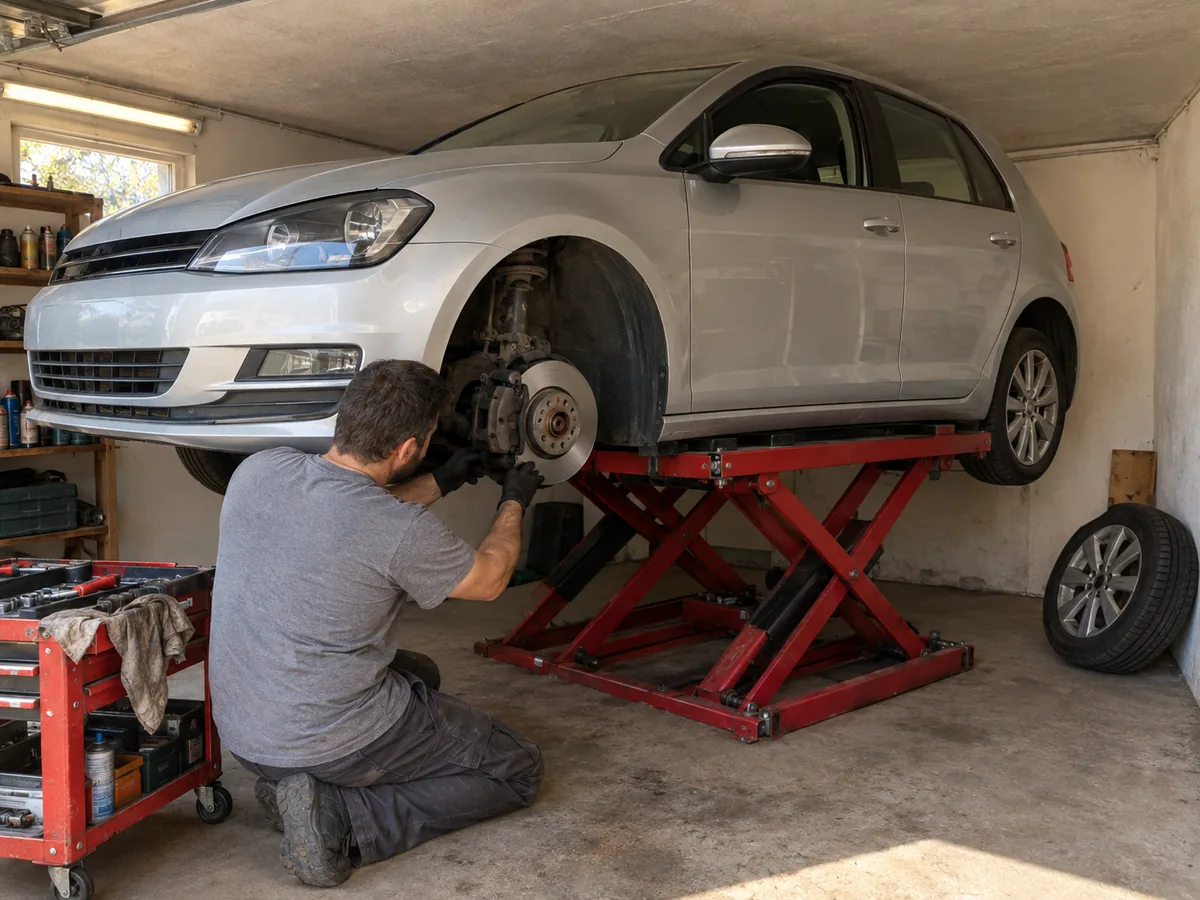
The flip side is access. The platform sits right under the middle of the car, so the transmission, transfer case, center exhaust and fuel tank are harder to reach than on a 2 post lift. For anything wheel-related, though, a scissor lift is quicker to load and quicker to work on than any other lift type.
4 Post vs Scissor Lift: Head-to-Head
Now let us put them against each other on the factors that actually decide the purchase.
Ceiling Height
This is the first filter and for many people the only one that matters. A 4 post lift needs enough clear height for the raised vehicle plus the runways plus whatever you park underneath. In real garages that means roughly 11 to 12 feet to stack two normal cars and 12 to 14 feet for trucks and SUVs. A standard lift will physically fit under a 10 foot ceiling, but you will not be able to raise a car all the way up.
A scissor lift barely cares about your ceiling. A low-rise unit works under an 8 foot ceiling, and a mid-rise lift is comfortable in 9 to 10 feet according to installer guidance from Auto Lift Services. If you have a standard 8 foot tract home garage, the scissor lift has already won this round.
Winner: Scissor lift, decisively, for anything under 11 feet.
Floor Space and Footprint
A 4 post lift is a permanent structure. Expect a footprint of about 10 feet wide by 17 to 20 feet long once you include the ramps, and remember that the columns and runways are there whether or not a car is on them. In a two car garage that usually means the lift owns one bay for good.
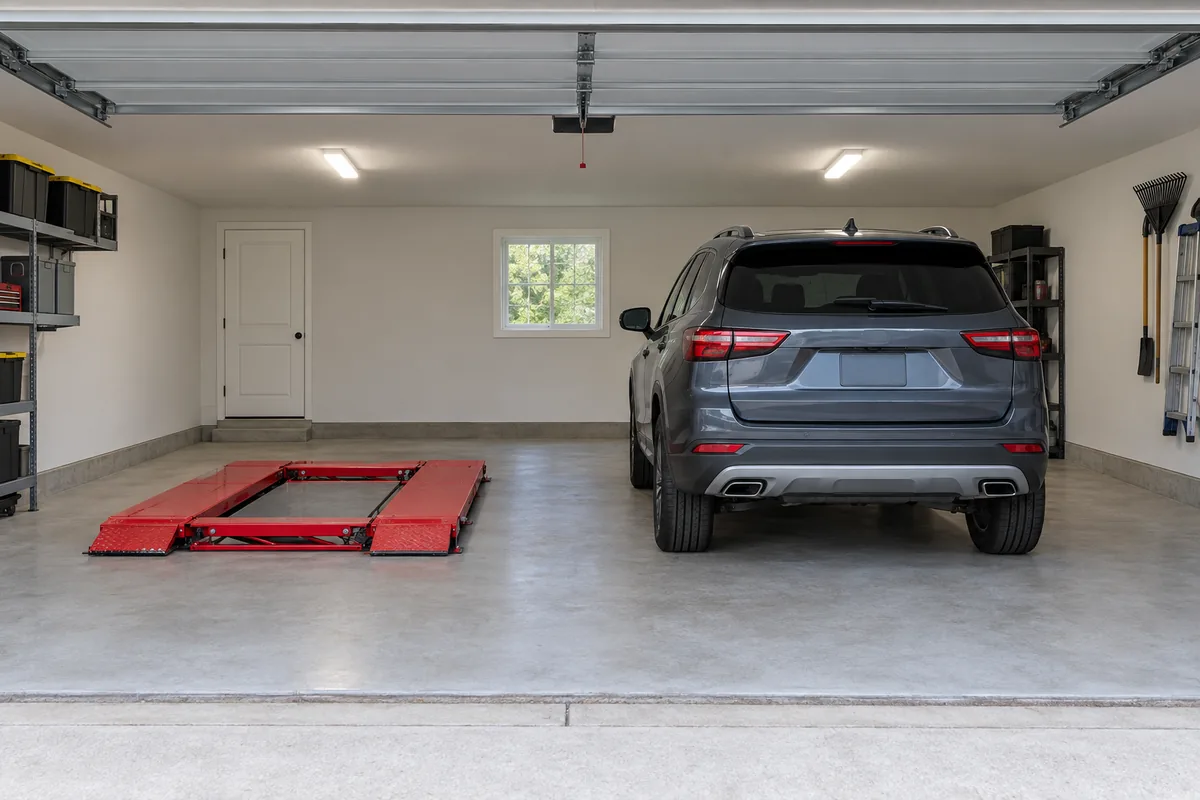
A mid-rise scissor lift lowers to a low flat platform that many owners simply park over, and a portable low-rise lift folds into two frames that lean against a wall. If floor space is the constraint, nothing beats a scissor lift except an in-ground lift.
Winner: Scissor lift.
Vehicle Storage
Here the 4 post lift has no competition. Raise the weekend car, park the daily driver underneath, and you have added a parking space to your garage for the cost of a lift. Add drip trays and a jack tray and you have a proper storage platform. Many owners buy a 4 post lift purely for this and treat the service ability as a bonus.
A scissor lift stores nothing. It is a service tool, full stop.
Winner: 4 post lift, by a mile.
Type of Work
Think about what you actually do on a Saturday. If it is oil changes, exhaust, inspections, undercoating and detailing, a 4 post lift is fantastic because you drive on and go, and you can stand upright underneath. If it is brakes, tires, wheel bearings, control arms, coilovers, sway bars or anything else that needs the wheels off, a scissor lift gets you there faster and without buying bridge jacks.
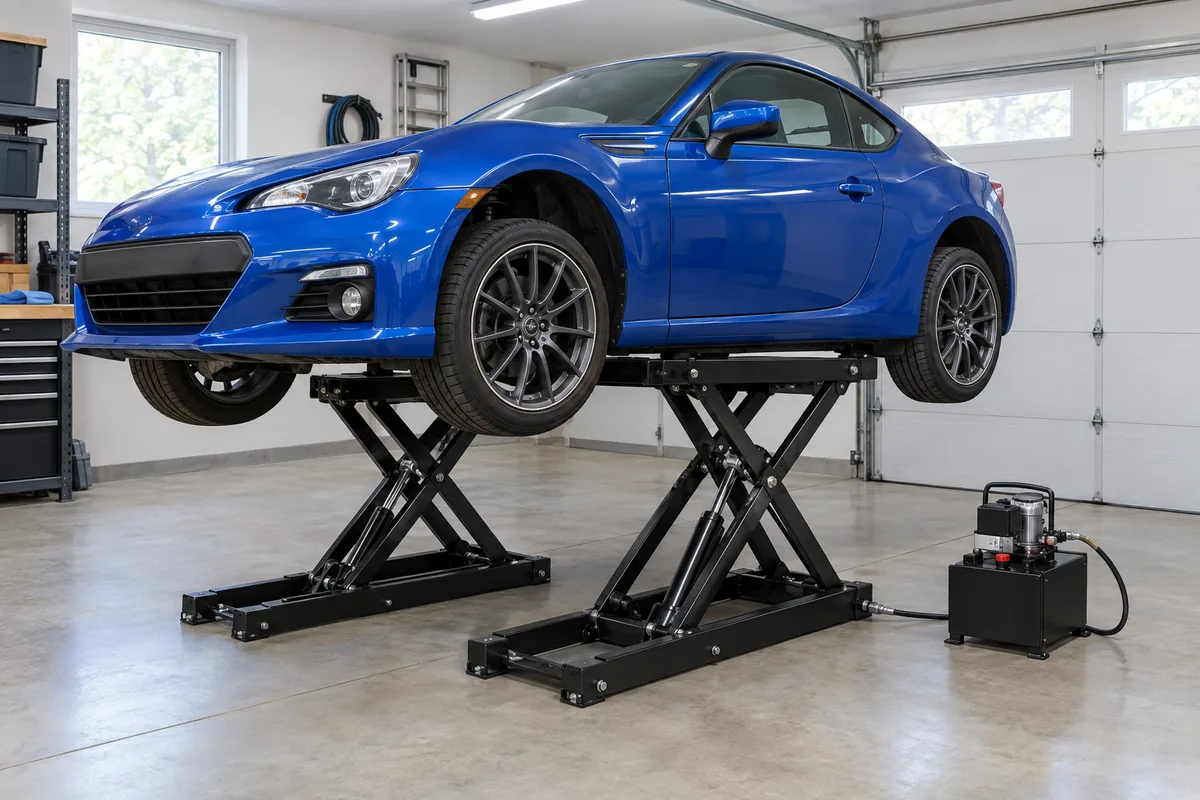
Neither lift gives you the open center access of a 2 post lift. The 4 post runways block the middle of the car, and the scissor platform blocks it in a different way. For transmission and clutch jobs, both are compromises, though a 4 post lift with bridge jacks at standing height is the more comfortable of the two.
Winner: Tie. Scissor for wheels-off work, 4 post for drive-on and under-car standing work.
Capacity
Home garage 4 post lifts start around 7,000 lbs and run to 14,000 lbs, with commercial models well beyond that. Low-rise scissor lifts top out around 8,000 lbs, and mid-rise units at roughly 10,000 lbs. Full-rise scissor lifts reach 18,000 lbs but are priced accordingly. If you own a three-quarter ton or one-ton truck, the 4 post lift is the easier and cheaper way to lift it safely.
Winner: 4 post lift for heavy trucks; even for passenger cars and half-ton pickups.
Installation and Concrete
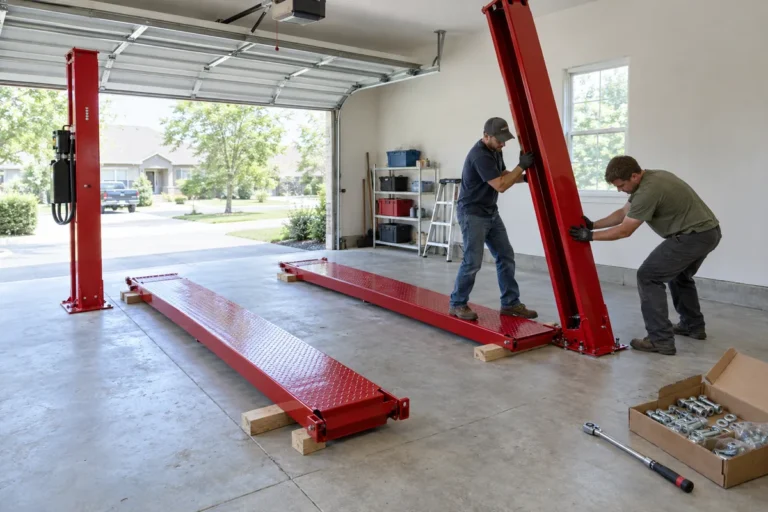
A 4 post lift ships on a pallet weighing 1,500 to 2,200 lbs, takes two or three people most of a day to assemble, and should be anchored into at least 4 inches of 3,000 PSI concrete. If you are curious about whether a 4 post lift needs to be anchored, we cover that debate in detail. You will also want a 220V circuit for most models.
A portable low-rise scissor lift needs no installation at all. Slide the frames under the car, plug the power unit into a 110V outlet and lift. A mid-rise scissor lift is a bolt-down job over a much smaller footprint and typically needs the same 4 inch, 3,000 PSI slab. Flush-mount full-rise units require a pit and add thousands to the install.
Winner: Scissor lift, especially the portable models.
Price
Budget decides a lot of these arguments. Based on 2026 pricing compiled by Car Lift Lab, portable scissor lifts run $1,000 to $2,150, mid-rise scissor lifts $2,000 to $5,000, and home 4 post lifts $2,500 to $8,000 with most buyers landing between $3,000 and $5,000. Full-rise scissor lifts jump past $10,000.
Add the hidden costs to get a real number. A 4 post lift may need $200 to $500 of electrical work for a 220V circuit, $500 to $1,500 for professional installation if you do not do it yourself, and $1,000 to $2,400 for a pair of bridge jacks if you want wheels-free service. A portable scissor lift costs what it costs, and that is it.
Winner: Scissor lift for entry price; 4 post lift for value per pound and per parking space.
Safety
Both lift types are safe when they are ALI certified, installed on adequate concrete and used within their rating. A 4 post lift is inherently stable because the vehicle sits on its tires on a wide base, and mechanical locks catch it at every position. A scissor lift relies on you placing the rubber blocks on the correct lift points every single time, and on cheaper units the locks engage at fewer positions. Neither is dangerous, but the scissor lift asks a bit more of the operator.
Winner: Slight edge to the 4 post lift.
4 Post Lift Pros and Cons
| Pros | Cons |
|---|---|
| Stores a second vehicle underneath | Needs 11 to 14 ft of ceiling to stack cars |
| Drive on, no lift points to find | Permanent 10 x 17 ft footprint |
| Highest capacity per dollar | Tires stay loaded; bridge jacks cost extra |
| Standing height under the car | Runways block the center of the undercarriage |
| Very stable with mechanical locks at every position | Heavy pallet, day-long assembly, usually 220V |
| Often freestanding, moveable with caster kits | Overkill if you only do wheel and brake work |
Scissor Lift Pros and Cons
| Pros | Cons |
|---|---|
| Works under 8 to 10 ft ceilings | No vehicle storage |
| Tiny footprint; lowers flat or stores against a wall | Platform blocks center undercarriage access |
| Wheels free instantly, ideal for brakes and suspension | Mid-rise height means working seated or crouched |
| Lowest entry price, portable units need no install | Lower capacity on affordable models |
| Runs on 110V on many models | Must locate lift points correctly every time |
| Loads a car in under a minute | Full-rise models cost as much as a commercial lift |
Which One Should You Buy?
Here is how I answer that weekly email.
Buy a 4 Post Lift If…
- You want to park two cars in one bay or store a project car long term.
- Your garage has at least 11 feet of clear ceiling, ideally 12 or more.
- You can give up a permanent 10 by 17 foot footprint.
- You own trucks or SUVs over 7,000 lbs.
- Your typical jobs are oil changes, exhaust, inspections, detailing and drive-on convenience.
Buy a Scissor Lift If…
- Your ceiling is 8 to 10 feet.
- Floor space is tight and you need the lift to disappear when you are done.
- Your work is mostly wheels, brakes, suspension and oil changes.
- You want the lowest total cost and the simplest installation.
- You rent, or may move, and want a lift that comes with you.
My verdict: for a storage-first garage with tall ceilings, the 4 post lift is the best money you will spend. For a low ceiling, service-first garage, a mid-rise scissor lift is the smarter buy, and a portable low-rise unit is the best value in the entire car lift market.
And if you keep coming back to full undercarriage access as your top priority, neither of these is the answer. That is when you should be looking at a 2 post lift instead.
Frequently Asked Questions
Is a 4 post lift better than a scissor lift?
A 4 post lift is better for vehicle storage, heavy trucks and drive-on convenience. A scissor lift is better for low ceilings, small garages and wheels-off work such as brakes and suspension. Neither is universally better; the right choice depends on your ceiling height, floor space and the type of work you do.
Can you store a car on a scissor lift?
Not in the way you can with a 4 post lift. A scissor lift raises one car and nothing parks beneath it. Most manufacturers also advise against leaving a vehicle raised long term on a scissor lift, while 4 post lifts are designed for exactly that.
What ceiling height do I need for a 4 post lift vs a scissor lift?
Plan on 11 to 12 feet of clear ceiling to stack two normal cars on a 4 post lift and 12 to 14 feet for trucks. A low-rise scissor lift works under an 8 foot ceiling and a mid-rise scissor lift needs about 9 to 10 feet. Full-rise scissor lifts need 12 feet or more, similar to a 4 post lift.
Does a scissor lift need to be bolted down?
Portable low-rise scissor lifts do not need any anchoring. Mid-rise and full-rise scissor lifts are normally bolted to at least 4 inches of 3,000 PSI concrete per the manufacturer’s instructions. Most 4 post lifts can be used freestanding but anchoring is recommended for stability.
Which is cheaper, a 4 post lift or a scissor lift?
In 2026 a portable scissor lift costs about $1,000 to $2,150 and a mid-rise scissor lift $2,000 to $5,000, while home 4 post lifts run $2,500 to $8,000 before electrical work, installation and bridge jacks. Full-rise scissor lifts are the most expensive of all at $10,000 and up.
Can you do brakes on a 4 post lift?
Yes, but only with rolling bridge jacks that span the runways and lift the car off its tires. Without them the wheels stay loaded. A scissor lift lifts by the frame, so the wheels are free immediately without any accessories.
Is a scissor lift safe for a home garage?
Yes, provided you buy an ALI certified or well-reviewed model, install it on adequate concrete, place the rubber blocks on the manufacturer’s lift points and stay within the rated capacity. Always lower the lift onto its mechanical locks before working underneath.
Final Thoughts
The 4 post vs scissor lift decision gets a lot easier once you stop asking which lift is better and start asking what your garage can hold and what you actually do in it. Measure your ceiling at the lowest obstruction, tape out the footprint on the floor, and be honest about whether you are buying a parking space or a workbench for your car.
If the tape says 11 feet or more and you dream of stacking two cars, buy a 4 post lift and never look back. If the tape says 8 to 10 feet, or you would rather have the floor back on Sunday night, a scissor lift will make you happier and leave money in your pocket. Either way, buy a certified lift, install it properly, and it will outlast every car you put on it.