4 Post vs 2 Post Car Lift: Which One Should You Buy?
If you have made it as far as pricing out a car lift for your garage, you already know the argument comes down to two machines. The 4 post vs 2 post car lift question is the one I get asked more than any other, usually by someone standing in an empty bay with a tape measure in one hand and a budget in the other, trying to figure out which lift they will still be happy with in five years.
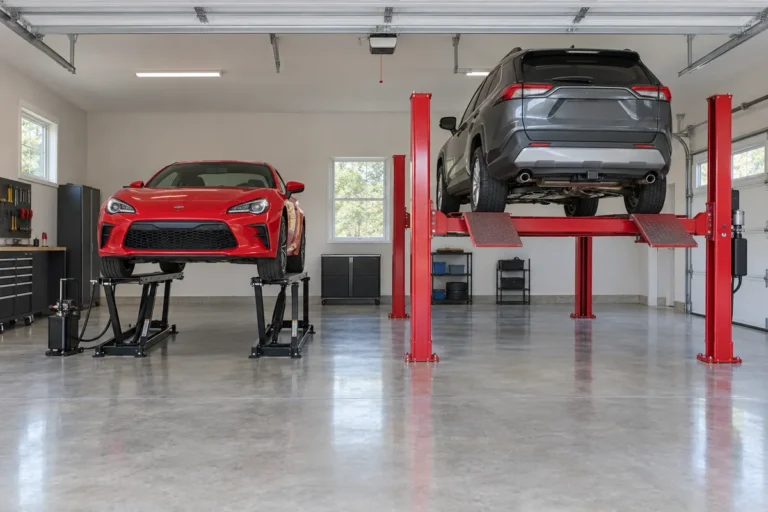
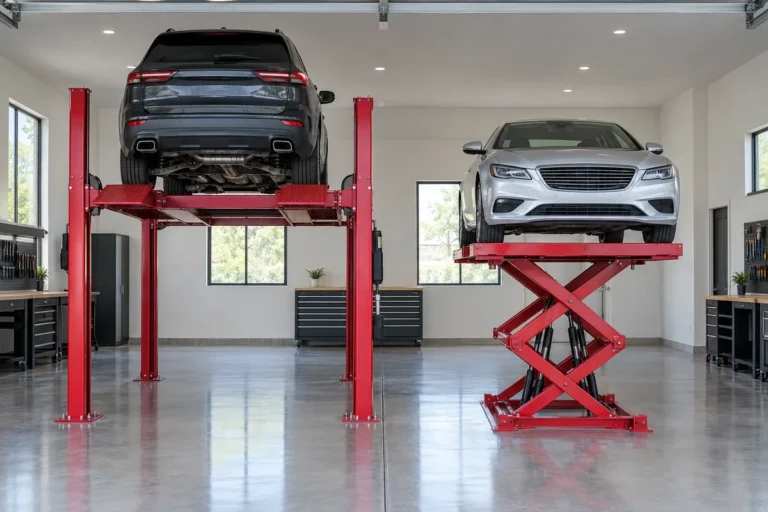
I have spent serious time under both. My 4 post lift is the reason I can keep a project car and a daily driver in the same bay. My 2 post lift is the reason I no longer dread clutch jobs, exhaust work or anything that involves pulling a wheel. They look similar in a catalog, they cost about the same, and they are built for almost opposite priorities.
In this comparison I will explain how each lift works, put them head to head on access, storage, ceiling height, footprint, concrete, safety and 2026 pricing, and then tell you plainly which one I would buy for different kinds of garages. If you are also weighing a scissor lift, read our 4 post vs scissor lift comparison alongside this one.
Quick Answer: Buy a 2 post lift if you are a serious DIY mechanic who wants full, wheels-free access to the entire underside of the car for brakes, suspension, transmissions and exhaust. Buy a 4 post lift if you want to store one car above another, prefer to drive on and go, own heavy trucks, or have concrete you do not fully trust. Both need roughly 11 to 12 feet of ceiling to lift a car to standing height, both run $2,500 to $8,000 for a good home unit, and the 2 post lift must always be anchored while most 4 post lifts can stand free.
Also Check:
- Best 4 Post Car Lift for the Money – Reviews & Buying Guide
- Best Two Post Lift to Buy – Reviews & Guide
- 4 Post vs Scissor Lift: Which Car Lift Is Right for Your Garage?
- Does a 4 Post Car Lift Need to Be Anchored? The Ultimate Guide
4 Post vs 2 Post Car Lift: Quick Comparison
Here is the short version. Everything below this table is the reasoning behind these numbers.
| Feature | 4 Post Lift | 2 Post Lift |
|---|---|---|
| Vehicle support | Tires on two runways | Frame or pinch welds on four swing arms |
| Typical home capacity | 7,000–14,000 lbs | 9,000–12,000 lbs (14,000+ available) |
| Max lift height | 70–78 in | 69–80 in |
| Ceiling needed | 11–14 ft to stack two cars; fits under 10 ft without full rise | 11–12 ft for clear-floor; 9–10 ft for baseplate models |
| Footprint | Roughly 10 ft x 17–20 ft, permanent | Two columns about 11–12 ft apart; open floor between them |
| Undercarriage access | Center blocked by runways | Full 360-degree access |
| Wheels-free work | Needs rolling bridge jacks ($500–$1,200 each) | Yes, instantly |
| Two-car storage | Yes | No |
| Loading time | About 30 seconds, drive on | 2–5 minutes positioning arms on lift points |
| Anchoring | Recommended; many models freestanding | Always required |
| Concrete | 4 in of 3,000 PSI minimum | 4 in of 3,000 PSI minimum; 6 in for heavier lifts |
| Installation | Medium to high; heavier and more parts | Medium to high; anchoring is critical |
| Power | 220V (some 110V) | 220V for most; some 110V |
| 2026 price | $2,500–$8,000 home; $5,000–$12,000 commercial | $1,800–$8,000; most buyers spend $2,500–$4,000 |
| Best for | Storage, drive-on service, heavy trucks | Full service and repair work |
Capacity, height and pricing figures are compiled from the 2026 lift comparison at Car Lift Lab, its car lift cost guide and the buyer’s guide at PitStop Pro. Always verify against the manual for the specific model you are considering.
How a 2 Post Car Lift Works
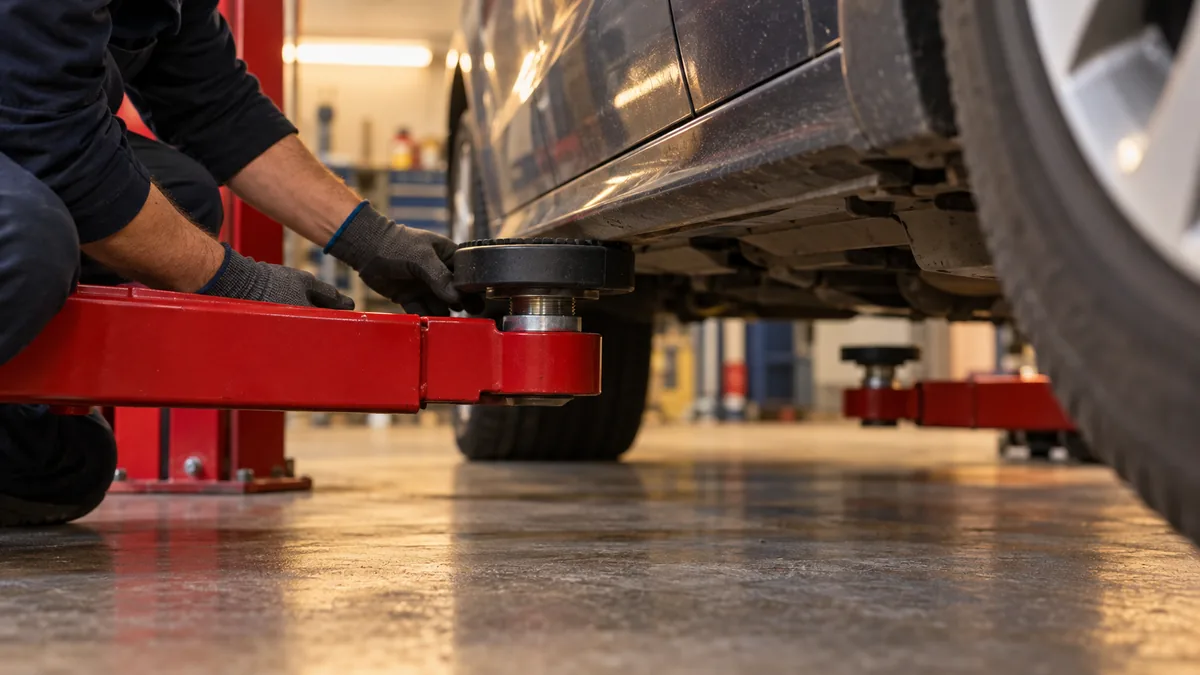
A 2 post lift is two steel columns bolted to the floor, each with a hydraulic cylinder and a carriage that rides up and down inside it. Four swing arms bolt to the carriages. You drive the car between the columns, swing the arms under the manufacturer’s lift points on the frame or pinch welds, set the rubber pads, and raise the car a few inches to check that it is sitting square. Then you take it all the way up. The two carriages are tied together with equalizer cables so both sides rise evenly, and mechanical locks click into place every few inches.
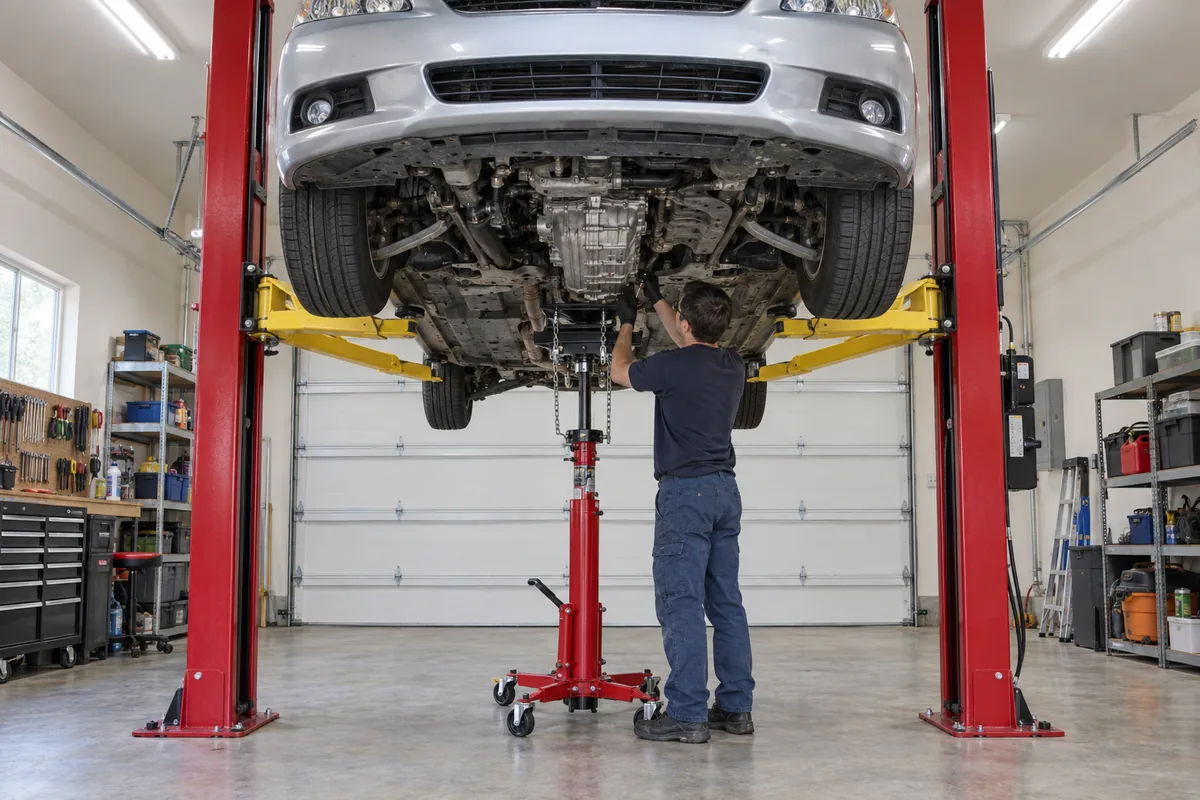
The payoff is obvious the first time you stand under a car with nothing in your way. Wheels off, exhaust exposed, transmission accessible, oil pan right there. Every professional shop is built around 2 post lifts for exactly this reason. If that is the kind of work you do, our roundup of the best 2 post car lifts covers the models I trust.
Two design choices matter when you shop. Symmetric lifts center the car between the columns and are simplest for trucks and long vehicles. Asymmetric lifts rotate the columns and use shorter front arms so the car sits further back, which lets you open the doors fully without hitting the posts. Clear-floor models route the hydraulic lines and cables over the top through an overhead beam and need about 11 to 12 feet of ceiling, while baseplate models run everything through a plate on the floor and can squeeze into a 9 to 10 foot garage.
How a 4 Post Car Lift Works
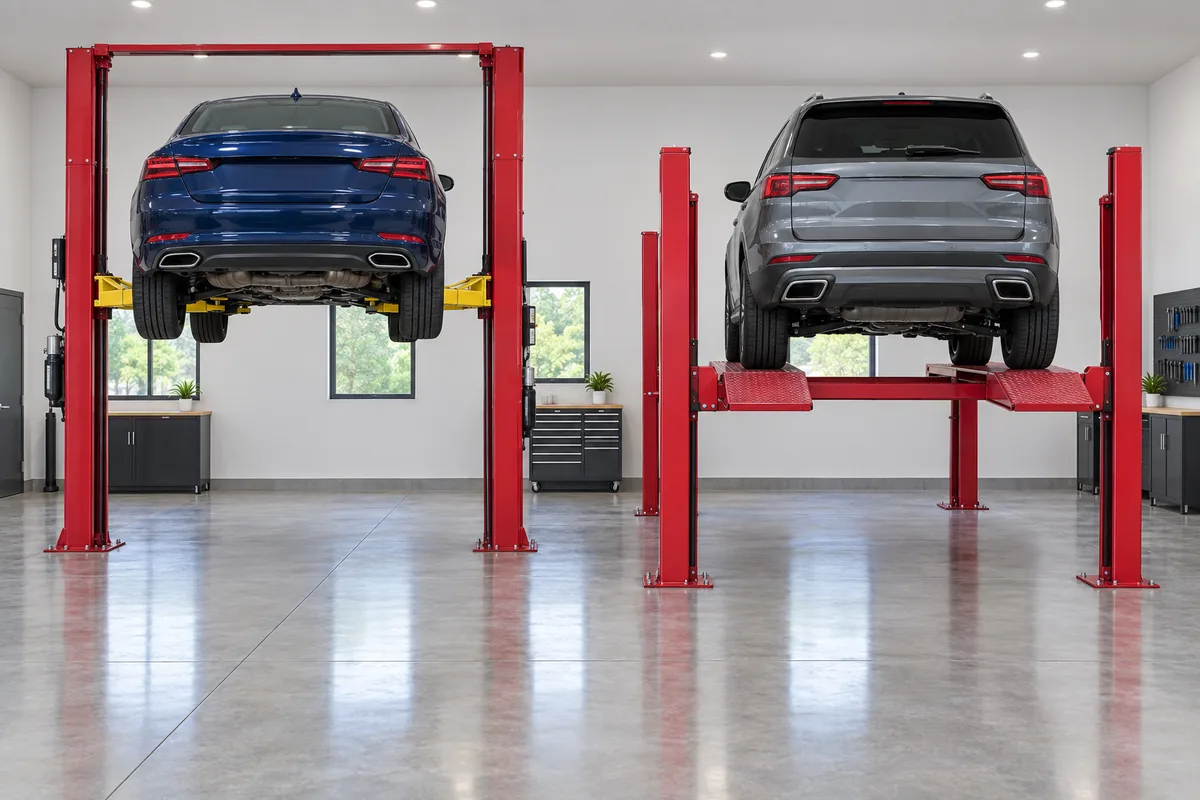
A 4 post lift is a drive-on platform. Four columns stand at the corners, two crossbeams connect them, and two runways sit on the crossbeams. You drive up the ramps, flip them up as wheel stops, and a single hydraulic cylinder pulls four equalizer cables that raise the runways evenly. Safety locks engage in each column as you go. Loading takes about half a minute and you never have to find a lift point or check a pad.
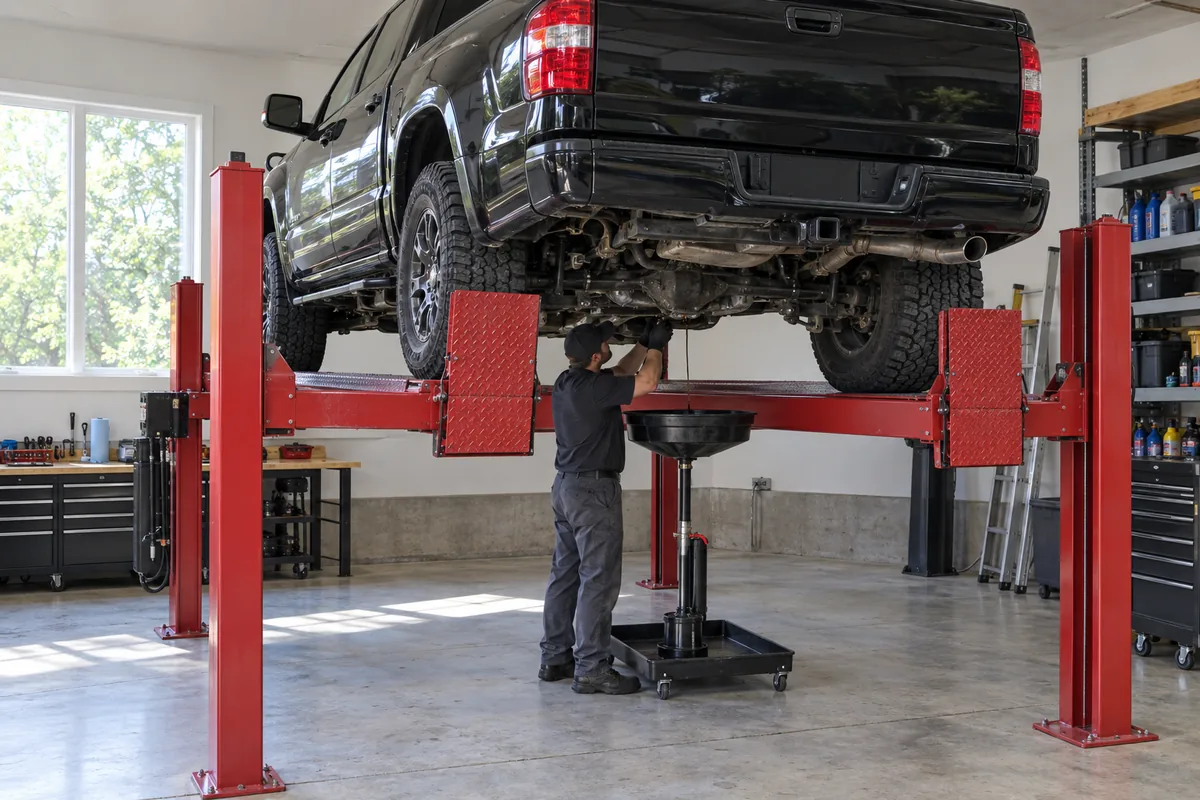
Because the car rests on its tires, a 4 post lift is the natural choice for long-term storage and for jobs where the wheels can stay put: oil changes, exhaust, inspections, undercoating, detailing, transmission fluid, differential service. To do brakes or suspension you add rolling bridge jacks that span the runways and lift the car off its wheels. Our guide to the best 4 post car lifts explains which models include jack trays and which are storage-only.
You can read a deeper explanation of runways, cable routing and lock systems in our installation coverage, but the key point for this comparison is simple: a 4 post lift supports the tires, a 2 post lift supports the frame, and nearly every difference below flows from that.
4 Post vs 2 Post Lift: Head-to-Head
Undercarriage and Wheel Access
This is the biggest single difference and the reason professional shops choose 2 post lifts. On a 2 post lift the car hangs from four small pads on its frame. Every wheel is free, the entire floor pan is exposed, and you can walk from the front bumper to the rear without ducking around anything. Transmissions, clutches, driveshafts, exhaust systems, fuel tanks, subframes: all straightforward.
On a 4 post lift, two runways run the length of the car right where you want to work. You can get to the center of the car from the sides and between the runways, but you are always working around steel. For wheel and brake work you must add bridge jacks, which adds cost and a second step every time. Pick up a lug wrench without them and you will quickly find the tires still carry the weight of the car.
Winner: 2 post lift, decisively.
Vehicle Storage
Now the roles flip. A 4 post lift is the only one of the two designed to hold a vehicle in the air indefinitely. Park the weekend car on the runways, lower it onto the locks, and park the daily driver underneath. Many manufacturers sell drip trays and jack trays precisely because this is how most home 4 post lifts spend their lives.
A 2 post lift can hold a car up overnight, but you should not store a car on one long term. The car rests on four small contact points, nothing can park beneath it safely, and most manufacturers advise lowering the lift when it is not in use.
Winner: 4 post lift, no contest.
Ceiling Height
The two lifts are closer here than most people assume. A clear-floor 2 post lift needs roughly 11 to 12 feet of ceiling because of the overhead beam, and its columns stand 12 feet or more on many 10,000 lb models. A baseplate 2 post lift trades the overhead beam for a floor plate and fits under a 9 to 10 foot ceiling, though you give up full rise on taller vehicles.
A standard 4 post lift will physically fit under a 10 foot ceiling, but to stack two normal cars you need about 11 to 12 feet, and 12 to 14 feet for trucks and SUVs. The math is lower car roof height plus runway thickness plus a 4 to 6 inch gap plus the upper car’s roof height, per the guidance at PitStop Pro. If the ceiling is tight, a high-lift garage door track and a wall-mounted opener can buy you 12 to 15 inches of usable height.
Winner: Tie. Under 10 feet a baseplate 2 post lift has a slight edge; above 12 feet both are happy.
Floor Space and Footprint
A 4 post lift claims a rectangle around 10 feet wide by 17 to 20 feet long and it never gives it back. The columns, crossbeams and runways stay whether or not there is a car on them. In a two car garage, the lift owns one bay.
A 2 post lift takes up two column footprints about 11 to 12 feet apart and leaves the floor between them open. When the lift is down you can park a car between the posts as if it were not there, roll a tool cart through, or use the bay normally. The columns do stick out from the wall, so door swing and the width of your garage matter more than with a 4 post lift.
Winner: 2 post lift.
Concrete and Anchoring
Here is where the 4 post lift earns back a lot of ground. A 2 post lift puts the full weight of the car into two columns that want to tip toward each other, so it must be anchored, without exception, into sound concrete. Most manufacturers call for a minimum of 4 inches of 3,000 PSI concrete for a 9,000 or 10,000 lb lift and 6 inches for heavier units, with no cracks or seams under the base plates. If your slab is thin, cracked or you do not know what is under it, you will be cutting and pouring new footings before the lift goes in.
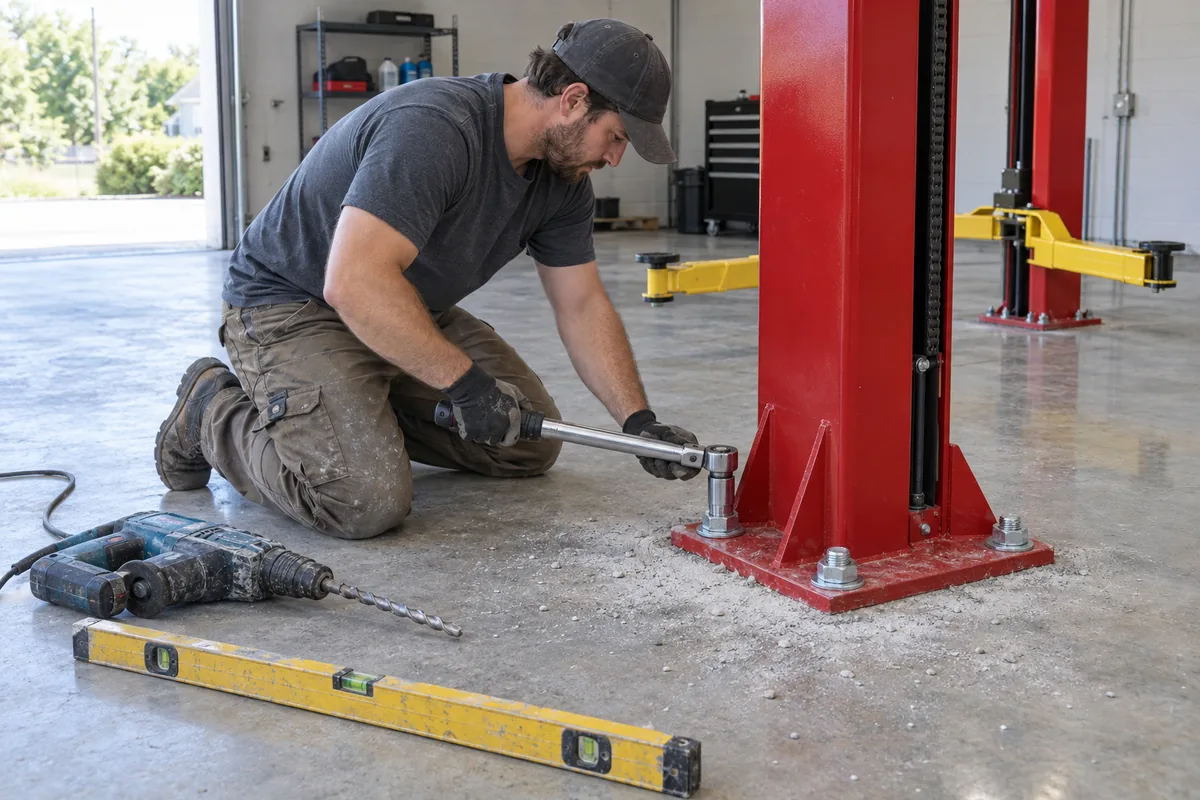
A 4 post lift spreads the load across four columns on a wide base and is stable freestanding, which is why so many home units ship without anchors and can even be fitted with caster kits and rolled around. Anchoring is still recommended, and we go through the arguments in our guide to whether a 4 post lift needs to be anchored, but a 4 post lift is far more forgiving of an ordinary residential slab.
Winner: 4 post lift.
Loading Speed and Ease of Use
A 4 post lift is the easiest lift in the world to use. Drive on, stop at the wheel stops, raise. Anyone in the household can do it, and you can do it ten times a day without thinking. A 2 post lift asks more of you every single time: position the car between the posts, swing each arm to the correct lift point, set the pad heights, lift a few inches, shake the car, check all four pads, then go up. Reckon on 2 to 5 minutes per vehicle, and more if the car has unusual lift points.
Winner: 4 post lift.
Capacity and Vehicle Size
For passenger cars and half-ton trucks, a 9,000 or 10,000 lb lift of either type is plenty. For heavy-duty trucks, dually pickups, long vans and heavier classics, the 4 post lift is easier to size correctly because the vehicle sits on its tires and weight distribution is not an issue. A 2 post lift has to be matched to the vehicle’s lift points and balance, and a long, front-heavy truck can be awkward on a symmetric lift and dangerous on an undersized one. Heavy 2 post lifts exist, but they need more concrete and more ceiling.
Winner: 4 post lift for trucks and mixed fleets; tie for cars.
Safety
Both types are safe when they are ALI certified, installed correctly and used within their rating. The difference is where the risk lives. A 4 post lift is inherently stable because the car sits on its tires on a wide platform, and the main risk is a vehicle that is too long or too tall for the runways. A 2 post lift is only as safe as its anchors and your lift point placement. Unbalanced loads, worn pads or a missed lift point can tip a car off the arms, which is why shops train technicians carefully and why you should always lower onto the locks before working underneath.
Winner: 4 post lift for the casual user; both are equal in trained hands.
Price and Total Cost
Sticker prices overlap almost completely. According to 2026 pricing from Car Lift Lab, 2 post lifts run $1,800 to $8,000 with most buyers spending $2,500 to $4,000, while home 4 post service lifts run $2,500 to $8,000 with a $3,000 to $5,000 sweet spot. Budget 4 post storage lifts start around $2,000.
The hidden costs tilt things. A 2 post lift usually costs more to install because of the anchoring, and any concrete work can add $1,500 or more. A 4 post lift may need $1,000 to $2,400 for a pair of bridge jacks before it does everything a 2 post lift does on wheels. Both typically need a 220V circuit at $200 to $500 if you do not already have one.
Winner: Tie. Budget $4,000 to $6,000 all in for either and you will not be surprised.
2 Post Car Lift Pros and Cons
| Pros | Cons |
|---|---|
| Full 360-degree undercarriage access | Cannot store a second vehicle underneath |
| Wheels free instantly, no accessories needed | Must be anchored into 4 to 6 in of sound concrete |
| Open floor between the columns when lowered | Loading takes 2 to 5 minutes and requires care |
| The professional standard for repair work | Balance and lift points matter on every vehicle |
| Baseplate models fit 9 to 10 ft ceilings | Clear-floor models need 11 to 12 ft |
| Usually cheaper for equivalent capacity | Columns intrude into a narrow garage |
4 Post Car Lift Pros and Cons
| Pros | Cons |
|---|---|
| Stores a second car underneath | Runways block center undercarriage access |
| Drive on in 30 seconds, no lift points | Needs bridge jacks for wheel and brake work |
| Stable freestanding; forgiving of ordinary slabs | Permanent 10 x 17 to 20 ft footprint |
| Easiest to size for heavy trucks and long vehicles | Needs 11 to 14 ft ceiling to stack two vehicles |
| Caster kits let you relocate it | Heavier pallet and more parts to assemble |
| Ideal for oil changes, exhaust, inspections and detailing | Overkill for pure storage if you never wrench |
Which One Should You Buy?
Here is the advice I give when someone sends me a photo of their garage.
Buy a 2 Post Lift If…
- You do real repair work: brakes, suspension, clutches, transmissions, exhaust, engine-out jobs.
- You have at least 4 inches of good 3,000 PSI concrete, or are willing to pour footings.
- You want the floor back when the lift is down.
- Your vehicles are cars, crossovers and light trucks with well-defined lift points.
- You have 11 to 12 feet of ceiling, or 9 to 10 feet and are happy with a baseplate model.
Buy a 4 Post Lift If…
- You want to park two vehicles in one bay or store a project car long term.
- You prefer drive-on convenience and want anyone in the family to be able to use it.
- Your slab is unknown, thin or cracked and you would rather not anchor.
- You own heavy trucks, duallies or long vehicles.
- Your typical jobs are oil changes, exhaust, inspections and detailing, with brakes handled by bridge jacks.
My verdict: if you turn wrenches for fun and the concrete is good, buy the 2 post lift and never look back. If you want a parking space with a side of service, or you are not sure about your slab, the 4 post lift is the safer, easier, more versatile buy for a home garage.
If neither sounds right because your ceiling is 8 or 9 feet, a scissor lift may be the answer, and our 4 post vs scissor lift comparison explains when it wins.
Frequently Asked Questions
Is a 4 post lift better than a 2 post lift?
Neither is universally better. A 2 post lift is better for repair work because it gives full undercarriage access with the wheels free. A 4 post lift is better for storage, drive-on convenience, heavy trucks and garages with questionable concrete. Choose based on the work you do and the space you have.
Which is safer, a 2 post or 4 post lift?
A 4 post lift is more forgiving for casual users because the vehicle sits on its tires on a wide, stable platform and most models are stable freestanding. A 2 post lift is equally safe when it is properly anchored and the arms are placed on the correct lift points, but it depends more on the operator. Always buy an ALI certified lift and lower it onto the mechanical locks before working underneath.
Does a 2 post lift have to be bolted to the floor?
Yes, always. A 2 post lift concentrates the load in two columns and must be anchored into at least 4 inches of 3,000 PSI concrete, with 6 inches recommended for heavier lifts. Most 4 post lifts can be used freestanding, though anchoring is still recommended.
What ceiling height do I need for a 2 post vs 4 post lift?
A clear-floor 2 post lift needs about 11 to 12 feet, and a baseplate 2 post lift fits under 9 to 10 feet. A standard 4 post lift fits under a 10 foot ceiling but needs roughly 11 to 12 feet to stack two cars and 12 to 14 feet for trucks and SUVs.
Can you store a car on a 2 post lift?
Not long term. A 2 post lift holds the car on four small pads and nothing can be parked safely beneath it. Manufacturers generally advise lowering a 2 post lift when it is not in use. A 4 post lift is designed for long-term storage with a second vehicle underneath.
Which is cheaper, a 2 post or a 4 post lift?
Prices overlap. In 2026, 2 post lifts run about $1,800 to $8,000 with most buyers spending $2,500 to $4,000, and home 4 post lifts run $2,500 to $8,000 with a $3,000 to $5,000 sweet spot. A 2 post lift usually costs more to install, while a 4 post lift needs $1,000 to $2,400 in bridge jacks for wheels-free work.
Can you do brakes on a 4 post lift?
Yes, with rolling bridge jacks that span the runways and lift the car off its tires. Without them the wheels stay loaded. On a 2 post lift the wheels hang free as soon as the car leaves the ground, so no accessories are needed.
Do I need a 220V outlet for a car lift?
Most 2 post and 4 post lifts use a 220V power unit, though some models of each type are offered in 110V. Installing a new 220V circuit typically costs $200 to $500 and should be done by a licensed electrician.
Final Thoughts
The 4 post vs 2 post car lift decision is really a question about who you are in the garage. If you are a mechanic first, the 2 post lift gives you access nothing else can match and you will use it every weekend. If you are a collector, a commuter with a weekend toy, or someone who wants a lift the whole family can use without a briefing, the 4 post lift will make you happier and ask less of your concrete.
Measure your ceiling at the lowest obstruction, find out how thick your slab is before you fall in love with a lift, and be honest about the jobs you actually do. Get those three things right and either lift will be one of the best tools you ever buy.